Friday, 7 June 2019

Effects of Noise Pollution | Effects of noise pollution on human health

The effects of noise pollution depend on the susceptibility of the individual, nature of the noise, and duration of exposure.
The impact of noise on human health can be classified into the following categories.

1- Auditory Health Effects
2- Non-auditory Health Effects


Pyramid of Noise Pollution

1- Auditory Health Effects:

Noise pollution causes hearing loss: Hearing loss results from prolonged exposure to high noise levels.
Reduced hearing sensitivity: Exposure to occupational noise can significantly reduce hearing sensitivity.

2- Non-auditory Health Effects:

Non-auditory health effects of noise pollution are as following:

1- Mental Health Effects
2- Sleep Disturbances
3- Hypertension
4- Low Performance
5- Cardiovascular and Physiological Effects


1- Mental Health Effects:

 Noise in the industry can be a direct cause of general health problems. It can create conditions of psychological stress, which can in turn cause physiological stress reactions.

2- Sleep Disturbances:

It has been found that more sleeping medicines are consumed by people living in noisy areas than in quieter areas.

3- Hypertension:

Prolonged exposure to high-intensity industrial noise increases the risk of hypertension.

4- Low Performance:

Workers in the industry with high noise levels show slightly lower productivity than those in departments with lower noise exposure.

5- Cardiovascular and Physiological Effects:

High levels of noise are associated with a high risk of physiological changes such as hypertension, increased levels of heartbeat rate.

Aircraft noise exposure was related to more medical treatment for heart trouble and hypertension.


Effects of Noise Pollution

Tuesday, 4 June 2019

Soil Pollution Effects | Soil pollution impact on human health | Effects of soil pollution on plants


Soil Pollution

The effects of soil pollution can be categorized into the following types.

1) Effects on Human Health
2) Effects on Growth of Plant
3) Decreased Soil Fertility
4) Toxic Gases
5) Changes in Soil Structure

1) Effects on Human Health:


Soil Pollution Health Effects

Soil pollution can have several of harmful effects on human health. The harmful effects of soil pollution may come from direct contact with polluted soil or from contact with other resources, such as water, that have come in direct contact with the polluted soil. Plants that are grown in polluted soil continuously absorb the pollutants. Animals who eat these plants take on all the pollutants that plants have accumulated. Humans who eat vegetables and animals that have accumulated large amounts of soil pollutants may be poisoned.

2- Effects on Growth of Plant:


Environment

Most plants are unable to adapt when the chemistry of the soil changes so radically in a short period. The fertility slowly diminishes, making land unsuitable for agriculture and any local vegetation to survive. Unlike deserts, which are suitable for its native vegetation, such land cannot support most forms of life.


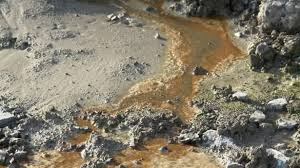
Effects of Soil Pollution

3- Decreased Soil Fertility:

The toxic chemicals present in the soil can decrease soil fertility and therefore decreases soil yield. The contaminated soil used to produce fruits and vegetables lacks quality nutrients and may contain some poisonous substances to cause serious health problems in people consuming them. 

4- Toxic Gases:

The emission of toxic gases from landfills pollutes the environment and causes serious effects on the health of many people. The unpleasant smell causes inconvenience to many people.

5- Changes in Soil Structure:

The death of many soil organisms (e.g. earthworms, bacteria, and fungi) can lead to alteration in soil structure. 

Several ways have been suggested to curb the rate of soil pollution:

Industries have been given regulations for the disposal of hazardous waste, which aim at minimizing the areas that become polluted. The organic method of farming is being supported, which does not use chemicals, pesticides, and fertilizers. The use of plants that can remove pollutants from the soil is being encouraged.


Soil Pollution


Monday, 3 June 2019

Air Pollution | Effects of Air Pollution: Effects of air pollution on human health | Effects of air pollution on plants | Effects of air pollution on environment

The effects of air pollution can be categorized into the following types.   

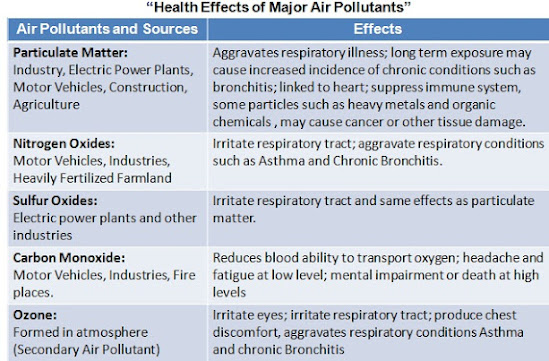
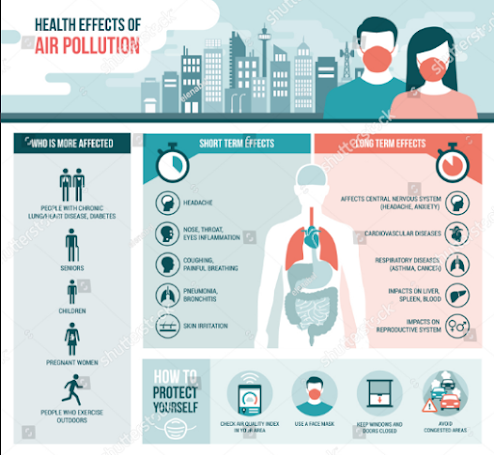
1) Impacts on Human Health

2) Impacts on Animals

3) Impacts on Plants

4) Impacts on Environment

1) Impact on Human Health:

Health Impacts of Air Pollution

  Chronic Bronchitis

2- Impacts on Animals:

  • Acid rain can harm fish and other wildlife.
  • Chlorofluorocarbon (CFCs) depletes ozone layer. As a result, ultraviolet radiations can penetrate through the atmosphere and cause skin cancer, and damages plants and wildlife.
  • Ozone molecules in the troposphere cause damaging effects on the lung tissues of animals.

3. Impacts on Plants:

  • A higher level of sulfur dioxide is harmful to plants and kills leaf tissues.
  • Nitrogen oxides cause the breakdown of plant tissues.
  • Peroxyacetyl nitrates  (PANs) have the highest toxicity to plants and attack younger leaves of plants.
  • Acid rain causes direct and indirect phytotoxicity to plants.
  • Acid rain causes depletion of nutrients cations (e.g. calcium and magnesium) from the soil. This results in reduced soil fertility and poor plant growth.

4. Impacts on Environment:

Particulate matter causes reduction and distortion of visibility. Smog causes damage to the materials and reduces visibility. Air pollutants react with one another and create acidic compounds. These compounds cause adverse effects on buildings and vegetation.

  • Greenhouse gases are the causes of climate change and global warming.
  • Some air pollutants (e.g. CFCs) cause ozone depletion
  • Acid rain causes corrosion of exposed structures, equipment, ornamental material, etc.


Health Effects of Air Pollution


Sunday, 2 June 2019

Water Pollution | Impacts on Human Health | Impacts on Aquatic Life | Impact on Soil | Water Pollution Facts

1) Impacts on Human Health:

  • Microbial contamination in water bodies causes diseases like cholera, dysentery, diarrhea, polio, typhoid, hepatitis, etc.
  • Heavy metals in drinking water can affect vital organs such as the kidney, liver, and nervous system.
  • Nitrates in drinking water cause blue baby syndrome in infants. It is a disease in which the blood cannot properly carry oxygen and the infant die. (decreased oxygen-carrying capacity of hemoglobin in babies leading to death)


2. Impacts on Aquatic Life:

  • Higher levels of nitrogen and phosphorus in agricultural run-off cause excessive growth of algae (Eutrophication). This process may result in oxygen depletion of the water body. 
  • The algae and other organisms eventually die off and bacteria may consume all the oxygen from the water during the decomposition of algae. This causes the death of fish in such water bodies due to low oxygen levels.
  • Pesticides affect aquatic life in the following ways.
  • Aquatic microorganisms are affected.
  • Decline of Amphibians
  • Fishkill


Water Pollution

Water Pollution Impact on Aquatic Life

3. Impact on Soil:

  • Untreated wastewater can adversely affect the soil system.
  • Water pollution can contaminate the soil with heavy metals and other pollutants.
  • Heavy metals affect the microbial activity in the soil.
  • Heavy metals affect the crop plants growing in the contaminated soil.


Water Pollution Impact on Soil

Water Pollution Effect on Soil

Water Pollution in Pakistan and its Impacts on Public Health,

Facts and Figures:

§  In Pakistan, 30% of all diseases and 40% of all deaths are due to poor

water quality. 

§  Among 122 nations of the world, Pakistan’s position is 80th concerning

drinking water quality. Sixty-four percent of bacterial contamination was

reported in the northern region of the country.

§  Every year around (250000) children in Pakistan die due to contaminated water.

§  In Pakistan 20-40 % of hospital beds are occupied by patients with

  waterborne diseases like diarrhea, hepatitis, typhoid, dysentery, cholera, 

  etc. One-third of all deaths occur across the country owing to waterborne diseases.


Water Pollution and Health Impacts across the World:

§  According to the world health organization (WHO), 80% of diseases

  are waterborne.

§  Worldwide, approximately polluted drinking water and insufficient

sanitation kill 1.6 million children below the age of 5 each year, 84%

of them are residing in villages.


Thursday, 30 May 2019

Sources of Noise Pollution | National Environmental Quality Standards for Noise | Measurement of Noise

The major sources of noise pollution are as following:

1) Industrial Sources
2) Transportation Noise
3) Domestic Noise
4) Noise from the leisure activities


1) Industrial Sources:

Industries are a big source of noise pollution both for inside workers and for the neighboring communities. In many areas of the world, the industries are isolated and separated to avoid noise pollution. The grinding machine, crushing machines, steam pressure release valves, and many other processes produce noise levels greater than 85 decibels (dB).

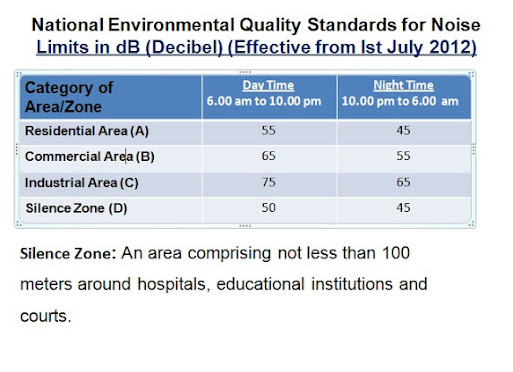
Permissible limits of Noise

2) Transportation Noise:

Following are the sources of noise pollution in the transportation sector.

a) Road traffic Noise
b) Rail Noise
c) Aircraft Noise


a) Road traffic Noise: 

It is the collective sound energy emanating from vehicles. It includes the running engine noise and friction of wheels. The noise of rolling tires driving on the pavement is found to be the biggest contributor to highway noise which increases with higher vehicle speeds.

b) Rail Noise:

The rail traffic noise is produced by the movement of the rails, especially the high-speed rails that produces a high level of noise. The rail noise is the specific problem at the stations and the neighboring community.

c) Aircraft Noise:

Aircraft landing and fly off produce a high-level noise. The main mechanism of noise generation in the early turbojet aircraft was the turbulence created by the jet exhaust mixing with the surrounding air. The noise source has been significantly reduced in the modern turbo-fan engines which surround the high-velocity jet exhaust with a lower velocity airflow generated by the fan. The fan itself can be a significant noise source, particularly during landing and taxiing operations.

3) Domestic Noise:

The use of domestic appliances (vacuum cleaners, washing machines, lawnmowers, etc), systems for music reproduction , TV sets, or hobby activities can be the major sources of domestic noise.

4) Noise from the leisure activities:

Various leisure activities can be a source of noise for others. For example, loud volume music or some games that create noise.


National Environmental Quality Standards for Noise


Measurement of Noise:

The noise level can be measured by using different meters.

1- Sound Level Meter (SLM)
2- Integrated Sound Level Meter (ISLM)
3- Noise Dosimeter.


Sound Level Meter
Sound Level Meter


Monday, 27 May 2019

Noise Pollution | Define noise pollution | Sound and Noise

Sound and Noise:

Sound can be defined as “vibrations that travel through the air or another medium and can be heard when they reach a person’s ear are collectively known as sound. Sound and noise can be distinguished in most simple words like the sound when becoming a source of discomfort or inconvenience for persons are called noise. Sounds are mechanical waves of pressure that are transmitted through solid, liquid, gas, or plasma. The matter that supports the sound waves from the source to the receiver is known as medium, however, sound cannot travel through a vacuum.


Noise Pollution

What is noise pollution?

Noise is a type of sound but is usually refers to loud and unwanted sounds.


What is Noise Pollution

Definition: Any unpleasant, unwanted, disturbing, or excessive sound that may disrupt the activity of human life is called noise, and such pollution is called noise pollution.

Noise is mainly caused by machines, transportation systems, trains, and air crafts. 

Propagation of sound or Noise:

The noise transmits from the source to the receiver through a medium like air, water, wood, or glass.

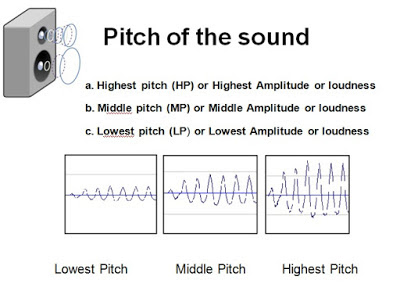
The transmission of noise depends upon the frequency and pitch of loudness. The frequency means the number of cycles completed in a second and pitch means loudness or amplitude.

Sound Waves

Frequency and Pitch of Sound


Pitch of Sound


Saturday, 25 May 2019

Causes of soil pollution | Causes of land pollution

The causes of soil pollution are classified into the following categories.

1) Municipal Solid Waste
2) Construction and Demolition waste
3) Hazardous Waste
4) Accidental Oil Spills
5) Agricultural Activities
6) Industrial Activities

Causes of Soil Pollution

1) Municipal Solid Waste: 

This class includes non-hazardous garbage, trash, and rubbish from homes,  institutions, markets, etc.

2) Construction and Demolition waste:

It includes wood, wallboard, concrete rubble, asphalt, metal objects, and other inert materials produced during construction activity.

3) Hazardous Waste:

It includes dangerous and harmful substances generated as liquid, solid, or sludge by various petroleum refineries, paper mills, chemical manufacturing companies, smelters, and many other industries. 

4) Accidental Oil Spills:

Oil leaks can happen during the storage and transport of chemicals. This can be seen at most of the fuel stations. The chemicals present in the fuel deteriorate the quality of soil and make them unsuitable for cultivation. These chemicals can enter into groundwater through the soil and make the water undrinkable.

5) Agricultural Activities:

Modern agricultural practices pollute the soil to a large extent. Huge quantities of fertilizers, pesticides, herbicides, and weedicides are added to soil to increase crop yield. The use of excess fertilizers to increase crop yields makes the soil either acidic or alkaline and pollutes it. Other chemicals damage the composition of the soil and make it easier to erode by water and air. Plants absorb many of the pesticides and when they decompose, they cause soil pollution since they become a part of the land.

6) Industrial Activities:

Industrial activity has been the biggest contributor to the problem in the last century, especially since the amount of mining and manufacturing has increased. Most industries are dependent on extracting minerals from the earth. Whether it is iron ore or coal, the by-products are contaminated and they are not disposed of in a manner that can be considered safe. As a result, the industrial waste lingers in the soil surface for a long time and makes it unsuitable for use.

Large quantity of solid wastes like unused and rejected chemicals(like sludge, press mud, sawdust, bottles, plastic materials, etc), unwanted industrial wastes generated during manufacturing processes are dumped over on the surface of the soil by almost all industries with a difference in the degree.

The larger the production base, the larger is the generation of wastes. Traditionally, these materials have been dumped around the city and causing soil pollution.


Soil Pollution Causes and Consequences
Soil pollution due to solid waste dumping

Waste | Definition of Waste | Types of Waste | Sources of Waste

Definition: Waste (also known as rubbish, trash, refuse, garbage, junk) is any unwanted or useless materials. Waste is any substance that is...